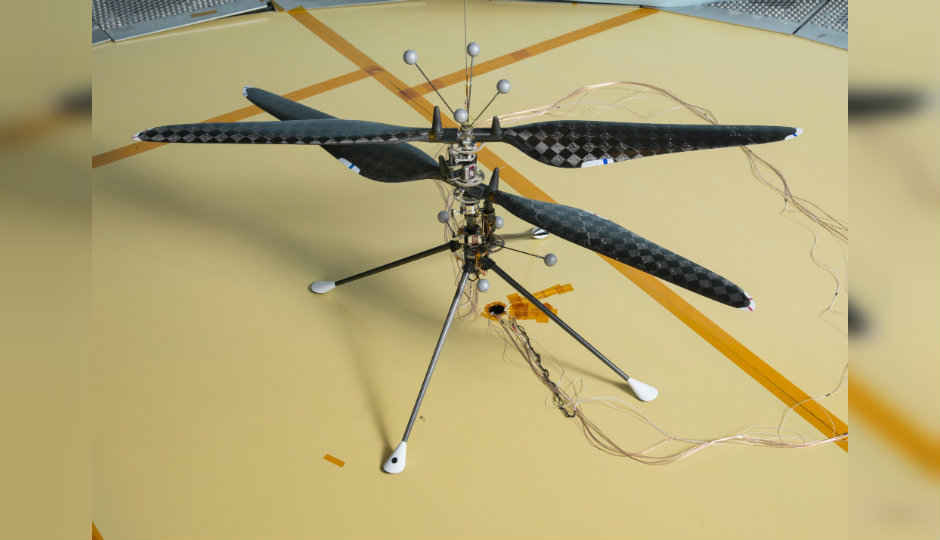
 Highlights The Mars Helicopter is scheduled to launch alongside the Mars Rover in 2020. It is a technology demonstrator and researchers hope to complete flights of 90 seconds on Mars. Researchers had to replicate the thin Martian atmosphere and lower gravitational pull here on Earth. Next year, NASA is set to launch a new mission to Mars. This time around, the US space agency plans to send a rover as well as a small helicopter. The team behind the helicopter has announced that they have compete test flights while simulating martian conditions. The Martian atmosphere as well as gravitational pull is very different than that on earth, so the team had to replicate those conditions in order to prove that their helicopter would be capable of flight. "Gearing up for that first flight on Mars, we have logged over 75 minutes of flying time with an engineering model, which was a close approximation of our helicopter," said MiMi Aung, project manager for the Mars Helicopter at NASA's Jet Propulsion Laboratory. "But this recent test of the flight model was the real deal. This is our helicopter bound for Mars. We needed to see that it worked as advertised." The helicopter itself weighs 1.8Kg, and in order to test it. Aung’s team had to mimic Martian conditions here on earth. They did this by using a 25 foot wide, (7.62m) vacuum chamber that sucked out all the air, and then injected carbon dioxide, the main ingredient of Mars’ atmosphere. The atmosphere was only one aspect, the second was to mimic the lower gravity on Mars. The researchers did so by using a ‘gravity offload system’, which is a motorized lanyard attached to the top of the helicopter. This would provide an “uninterrupted” tug equivalent to two-thirds of Earth’s gravitational pull. The team says that a hover of 5cm enough for them to obtain the data sets needed to confirm that the Mars Helicopter would fly autonomously as designed. "The next time we fly, we fly on Mars," said Aung. "Watching our helicopter go through its paces in the chamber, I couldn't help but think about the historic vehicles that have been in there in the past. The chamber hosted missions from the Ranger Moon probes to the Voyagers to Cassini, and every Mars rover ever flown. To see our helicopter in there reminded me we are on our way to making a little chunk of space history as well." [sic] The Mars Helicopter and the Mars 2020 rover will be launched aboard a United Launch Alliance Atlas V rocket in July 2020. It is expected to reach Mars in February 2021. The Mars Helicopter would launch as a technology demonstrator. After landing on Mars, it will be deployed and test flights of up to 90 seconds long will begin, a first from the surface of another planet. Recommended read NASA's Opportunity Rover Mission on Mars concluded after 15 years of exploration
from Latest Technology News https://ift.tt/2Fz4BUG
Comments
Post a Comment