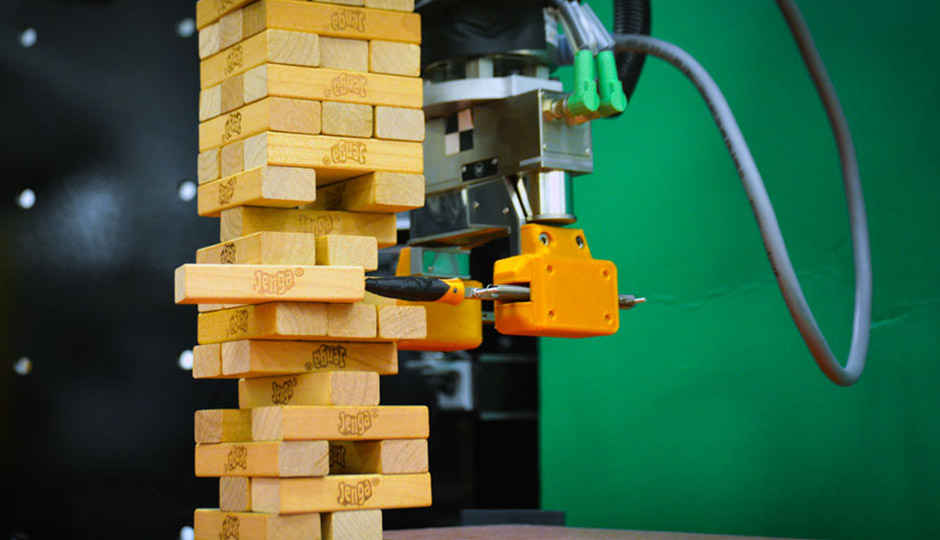
 Jenga, the popular block stacking game that has been the source of much amusement and plenty of frustration across the world, now has a new player. In a basement on the MIT campus, a team of scientists have taught a robot to play Jenga. The feat was achieved by a team led by MIT graduate student Nima Fazeli. This achievement is a remarkable one for the field of robotics, as Jenga is a game that requires complex understanding of the forces of physics such as push, pull, spatial arrangement. What makes their achievement special is that they achieved their goal using vision and touch, rather than just vision. For a robot to know how to play a game of Jenga using vision alone, the model would have to be trained to be trained for every single scenario that would transpire between the robot, the tower and the block(s). This would require far too many games, which was not feasible. The robotic arm is equipped is equipped with a gripped, a wrist cuff that senses the amount of force being exerted and a camera that allows the robot to “see.” The combination of pressure, force and vision allowed the system to learn all that it needs to about the game in far fewer training sessions. Alberto Rodriguez, the Walter Henry Gale Career Development Assistant Professor in the Department of Mechanical Engineering at MIT, said that “Unlike in more purely cognitive tasks or games such as chess or Go, playing the game of Jenga also requires mastery of physical skills such as probing, pushing, pulling, placing, and aligning pieces. It requires interactive perception and manipulation, where you have to go and touch the tower to learn how and when to move blocks,” Rodriguez says. “This is very difficult to simulate, so the robot has to learn in the real world, by interacting with the real Jenga tower. The key challenge is to learn from a relatively small number of experiments by exploiting common sense about objects and physics.” The team says that their technique goes beyond having robots play Jenga, and can instead be used on smartphone production lines for screwing and locking components into place. With the ability to sense resistance and force, the robots would be perfect for assembly line work.
from Latest Technology News http://bit.ly/2HIEpeu
Comments
Post a Comment