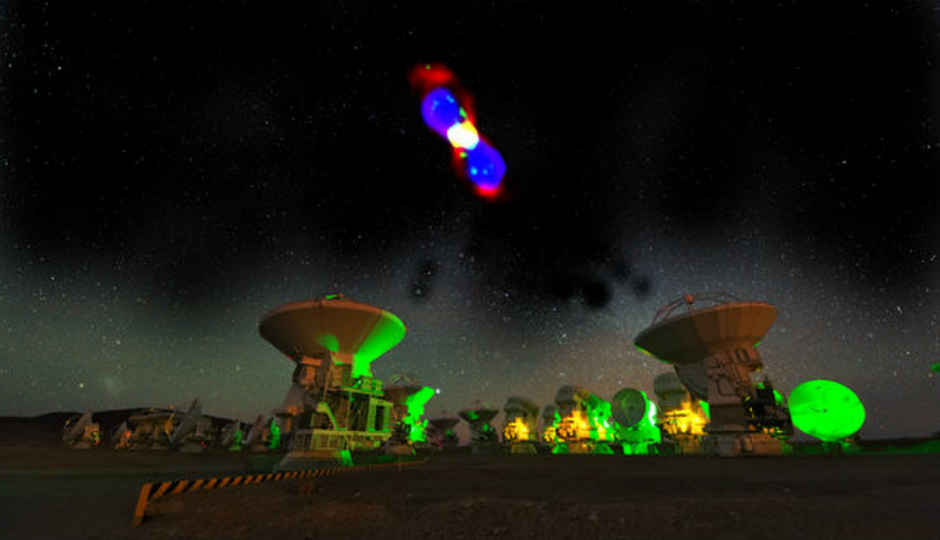
 For the first time ever, scientists have observed a radioactive molecule in space that originates from an ancient stellar explosion. As per Space.com, via a study published in the journal Nature Astronomy, the detected 26AlF radioactive molecule was radiated when a red nova occurred in the 17th century, which was observed by astronomers as a brightly shining phenomenon in the Vulpecula constellation. Red Nova is similar to a supernova, but instead of one, two stars are involved and they merge in an explosive event, which is followed by a cool off. While cooling-off, they produce large amounts of molecular gas and dust. The molecular gas, 26AlF is a radioactive isotope of aluminum in the leftovers of the Nova which is called CK Vul (or Nova Vul 1670). Even though space is filled with various kinds of radiations, it’s the first time a radioactive molecule has been detected there. Additionally, this is also the first time that an entity producing the radioactive 26AlF isotope has directly been identified. The discovery was made by an international research team led by Tomasz Kamiński from the Harvard-Smithsonian Center for Astrophysics. After three centuries, in 2013, astronomers linked the radiation of an unusual isotopic molecular gas to the stellar event. This rekindled interest in the Nova and now, the new investigation lead by Kamiński and his research team has shown that the Nova was likely caused by the merger of two stars in what is known as a Red Nova. As per a Max Planck Institute for Radio Astronomy report, observing the 26AlF molecule scientists will be able to better understand how the stars merged in the CK Vul. “The observations constrain the nature of the binary system that merged more than 300 years ago: a low-mass binary that contained a red-giant-branch star of a mass of 0.8-2.5 solar masses.” The observation is said to provide direct insight into the merger process in CK Vul, revealing that even the denser inner layers of stars can eventually be exposed in a stellar collision. Cover Image credits: T. Kamiński (composition); ESO/Y. Beletsky (ALMA photo)
from Latest Technology News https://ift.tt/2AtnSrs
Comments
Post a Comment